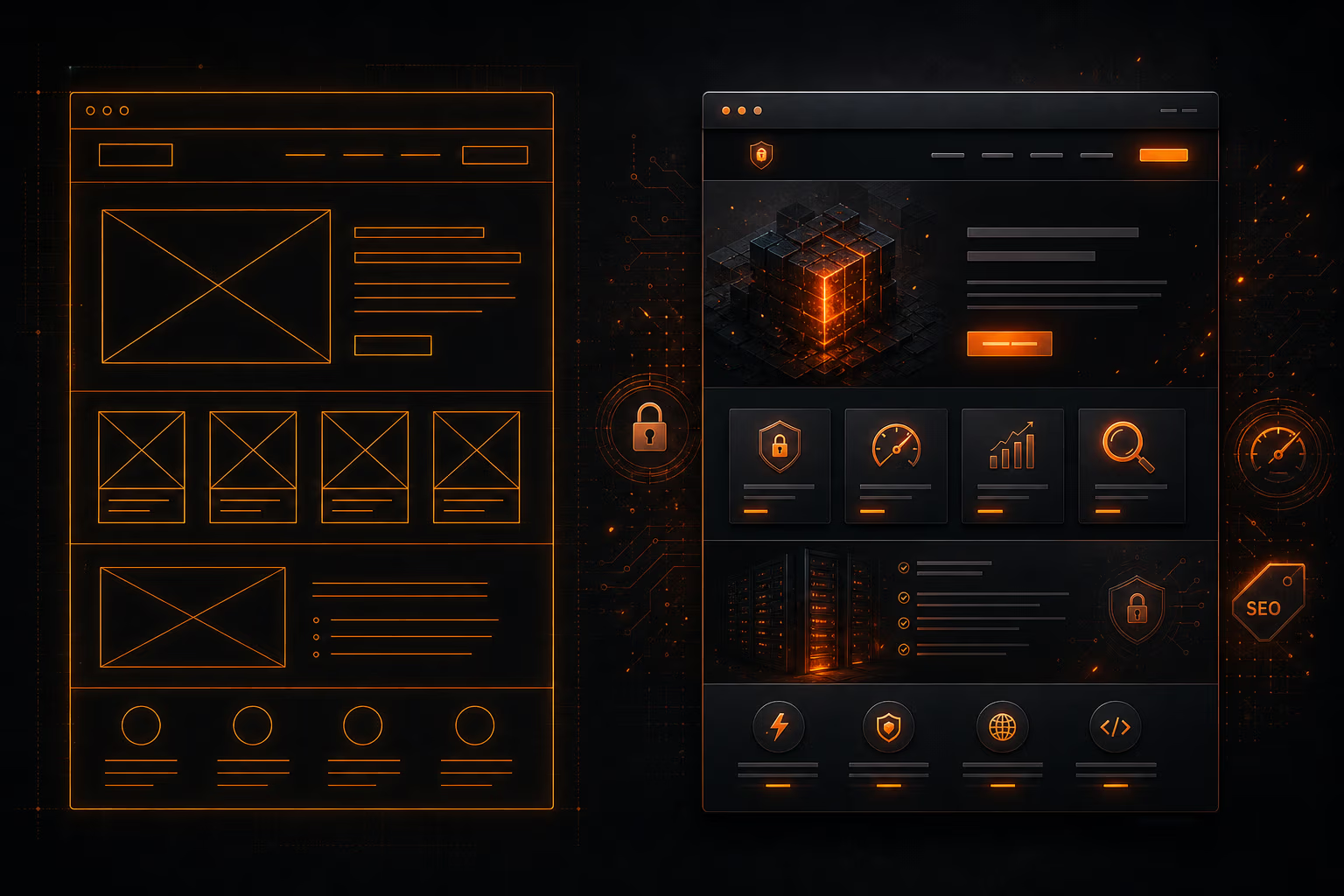
From Prompt to Production: The Real State of AI Website Builders
AI website builders can generate a site in minutes, but the gap between a draft and a production-ready business site is wide. Here's how DigiForge bridges that gap with real engineering.

Type a short description, and within minutes you get a clean homepage — hero section, services, testimonials, calls to action, the whole package. AI website builders have had their "wow moment," as TechTimes recently observed. That first draft that used to take days is now the starting line. But at DigiForge, we know that launching a real website has never been just about generating a page. Real sites need structure, search visibility, performance, security, and the ability to evolve without losing stability. That gap between a generated draft and an operational website is where the real work — and the real value — lies.
The Allure of Instant Websites
The promise is seductive: describe your idea in plain English and get a fully styled, multi-page site. With 69% of professional developers already using AI tools in 2024 (according to a survey cited in Memeburn's roundup), the market has exploded to $7.37 billion, as noted by HBR. Platforms like Wix, Framer, Webflow, and Hostinger all offer AI-powered site generation. Even Canva has entered the fray with an AI assistant that can call various design tools to create web-ready assets TechCrunch. The idea that anyone can now build a website is powerful — but it's also dangerously incomplete.
We've seen founders who, after a weekend of tweaking prompts, launch a site that looks acceptable. They celebrate — until their first real customer tries to complete a purchase and gets a Stripe error. Or until Google Search Console shows zero impressions because the generated XML sitemap is static and outdated. These are not edge cases; they are the norm when AI handles everything from start to finish without human engineering oversight.
The Hidden Checklist AI Builders Ignore
Most AI builders excel at the visual layer. You get something that looks finished — until you put it under real-world conditions. Then the hidden checklist shows up. Websites don't live in a vacuum. They need a real content system, safe editing, and stable integrations for analytics, forms, SEO, payments, and ecommerce. When those pieces aren't wired in cleanly, changes become risky, scaling gets painful, and the site quietly turns into a maintenance burden.
A generated site is a draft — not a delivery. The missing pieces are exactly what separate a toy from a tool.
What AI Builders Actually Deliver Well
- Visually coherent layouts based on a single prompt. You get a solid first impression that passes the eyeball test.
- Basic content — often placeholder text and generic images from stock libraries or AI generation.
- Simple navigation structures for small sites (5-10 pages) that are easy to follow.
- Fundamental SEO meta tags (title, description) that at least tell crawlers what the page is about.
- Core responsive behaviour (mobile-friendly out of the box), though often with untested breakpoints.
What They Typically Miss
- A structured content management system (CMS) that non-developers can use safely. AI builders often couple content to code, making updates risky.
- Role-based permissions and editorial workflows. Anyone with the link can edit, and there's no staging or revision history.
- Custom post types, taxonomies, and dynamic content relationships. A blog post is just a text block, not an entity with author, categories, and related posts.
- Advanced SEO: structured data, canonical tags, hreflang for multilingual sites, XML sitemaps that update automatically, and proper URL hierarchy.
- Performance optimisation: CDN configuration, image compression with WebP, lazy loading, code splitting, and database query caching.
- Security hardening: HTTPS enforcement, input validation, SQL injection prevention, CSRF tokens, rate limiting, and secure defaults.
- Third-party integrations that actually work end-to-end. A payment button that redirects to a fake checkout is not a payment gateway.
- Scalable hosting environment with staging, automated deployments, backups, and monitoring. AI builders often lock you into their hosting with no escape hatch.
- Maintainable codebase that can be extended without tearing down the original generation. AI code is often monolithic and uncommented.
As TechTimes puts it, "The gap between a generated draft and an operational website is where [tools like 10Web] are building bridges." But even those bridges require developer oversight. At DigiForge, we've audited dozens of AI-generated sites, and the pattern is consistent: the surface is shiny, but the infrastructure is hollow.
Bridging the Gap: From Draft to Production
At DigiForge, we've worked with clients who started with an AI-generated site and quickly hit a wall. Their business grew, but the site couldn't keep up. The fix isn't to abandon AI — it's to layer real engineering on top. Here's what that looks like in practice.
Content System and Safe Editing
An AI builder might give you a page with editable text blocks, but a real content system needs versioning, scheduled publishing, content previews, and user roles. We typically migrate AI-generated content into a proper headless CMS or a framework like WordPress with custom post types. This gives the marketing team the freedom to update content without touching a line of code — and without breaking the layout. Tools like Canva's AI assistant can generate design assets, but those assets need to be embedded within a structured content model that understands relationships between products, categories, and promotions.
For example, an AI-built ecommerce site might have a "Products" page with hardcoded HTML for each item. When the client wants to add a new product, they have to dig into the generated code — or regenerate the whole page, losing any customizations. We replace that with a database-driven catalog where adding a product is a form submission, and the layout adjusts automatically. That's not a feature request; it's a baseline requirement.
SEO and Performance
AI builders often generate decent meta titles and descriptions, but real SEO requires structured data (Schema.org), proper heading hierarchy, canonical URLs to prevent duplicate content, and XML sitemaps that are automatically updated. Performance is another area where AI falls short: it may produce a fast-loading page, but without a CDN, server-side caching, database query optimisation, and image compression strategy, that performance won't scale.
We regularly audit AI-generated sites and see render-blocking resources, oversized images, and missing cache headers. Fetching a page that looks fast on a local machine but takes 5 seconds on a 3G connection is not production-ready. At DigiForge, we run Lighthouse and WebPageTest as part of every build, and we optimise images (WebP, lazy loading), implement CDN with edge caching, and fine-tune server configuration (Gzip, Brotli, HTTP/2). For dynamic sites, we add Redis or Varnish. These steps are not glitzy, but they are what make a site fast for real users.
Security and Integrations
Security is where AI builders are most dangerous. They often leave default credentials, expose API keys in client-side code, and lack basic input sanitisation. A generated ecommerce site might have a "buy now" button that doesn't actually process payments securely. Real integrations require OAuth flows, webhook verification, idempotency keys, and thorough error handling. The AI can generate the front-end form, but the back-end workflow — Stripe payment intent creation, inventory management, tax calculation, shipping provider API calls — that's all custom engineering.
AI can generate a checkout page in seconds. Making it actually charge a credit card, securely, without leaking data, and with proper receipts — that still takes a developer.
We've seen AI-generated sites that hardcode Stripe publishable keys in the HTML source, or that skip server-side validation entirely. Those are vulnerabilities waiting to be exploited. Our approach is to treat every integration as a contract: we verify inputs server-side, use environment variables for secrets, implement rate limiting, and log all errors for monitoring. The AI can provide the scaffold, but the security architecture must be engineered by hand.
The Human Layer: Why Coders Are More Important Than Ever
There's a common fear that AI will make developers obsolete. HBR's Michael Li argues the opposite: "AI Tools Make Coders More Important, Not Less." The reasoning is straightforward. AI lowers the barrier to producing a first draft, but the complexity of taking that draft to production — handling edge cases, ensuring security, maintaining performance, integrating with other systems — has not decreased. If anything, it has increased, because the speed of generation means more drafts, more decisions, and more need for expert judgment.
In our experience, developers using AI tools become more productive, but they also become more critical: someone needs to review the AI's output, validate its assumptions, and make the thousands of tiny architectural decisions that turn a prompt into a reliable product. The $7.37 billion market for AI coding tools reflects this reality: the tools augment, not replace. At DigiForge, we embrace AI for rapid prototyping, content generation (like initial blog posts and logo variations), and even writing boilerplate code. But we always treat the AI output as a starting point, not a finish line.
Consider a recent project: a client used an AI site builder to create a directory for local businesses. The generated site had a search bar and category pages. But the search only filtered the visible DOM elements — it didn't query a database. When the directory grew to 500 entries, the page became unresponsive. We rebuilt it with a proper backend, Elasticsearch, and pagination. The AI saved two days of initial layout work, but we spent two weeks on the architecture that made the site actually usable at scale.
DigiForge's Production Checklist for AI-Generated Sites
When a client comes to us with an AI-generated site, we don't throw it away. We assess it against a rigorous production checklist. This is the same process we use for any site we build from scratch, but with extra attention to the gaps AI tends to leave.
- Is the content structured in a way that scales? If not, we move it into a proper CMS with custom post types, taxonomies, and version control.
- Are all third-party integrations wired securely? We audit API keys, authentication flows, and error handling. We ensure sensitive data never touches the client side.
- Does the site meet Core Web Vitals? We run Lighthouse and WebPageTest on real mobile and desktop connections, then optimise images, implement code splitting, configure caching, and fine-tune server response times.
- Is the SEO foundation solid? We add structured data (Product, Article, LocalBusiness as needed), fix URL hierarchies, implement canonicals, generate dynamic XML sitemaps, and set up hreflang tags for multilingual sites.
- Is the hosting environment bulletproof? We set up staging, automated deployments (CI/CD), daily backups with tested restores, and monitoring (uptime, errors, performance alerts).
- Can the site evolve without breaking? We refactor the AI-generated code into modular components, add comprehensive error handling, and write tests for critical paths (payment, forms, search).
After assessment, we build the missing pieces: editorial workflows, role-based access, analytics dashboards, and any custom features the business needs. The result is a site that started as an AI prompt but ends as a production-grade digital asset — one that can handle growth, traffic, and real business logic.
We've seen this approach turn around sites that were on the verge of being scrapped. One client, an online retailer, had an AI-generated site that looked beautiful but couldn't handle more than 10 concurrent users. After our audit, we re-architected the backend, connected it to a real inventory system, and set up Cloudflare for caching and DDoS protection. The site now serves thousands of visitors daily without a hitch.

If you're considering an AI website builder — or if you already have a generated site that's not quite working — we can help. Contact DigiForge to discuss turning your draft into a reliable, scalable product. We'll bring the engineering depth that bridges the gap between prompt and production.
The AI revolution isn't about replacing developers. It's about raising the floor — and the ceiling. But between those two levels, there's still a lot of solid engineering required. And that's exactly the kind of work we love. At DigiForge, we've built our practice around the conviction that AI can accelerate the creative process, but it cannot substitute for the judgment, experience, and attention to detail that a production-ready site demands.