Technical SEO for AI Search: What Actually Matters in 2026
AI search is reshaping SEO. Learn the key technical factors—sub-200ms load times, crawl efficiency, structured data, and trust—that determine visibility in generative engines. A practical guide from DigiForge.
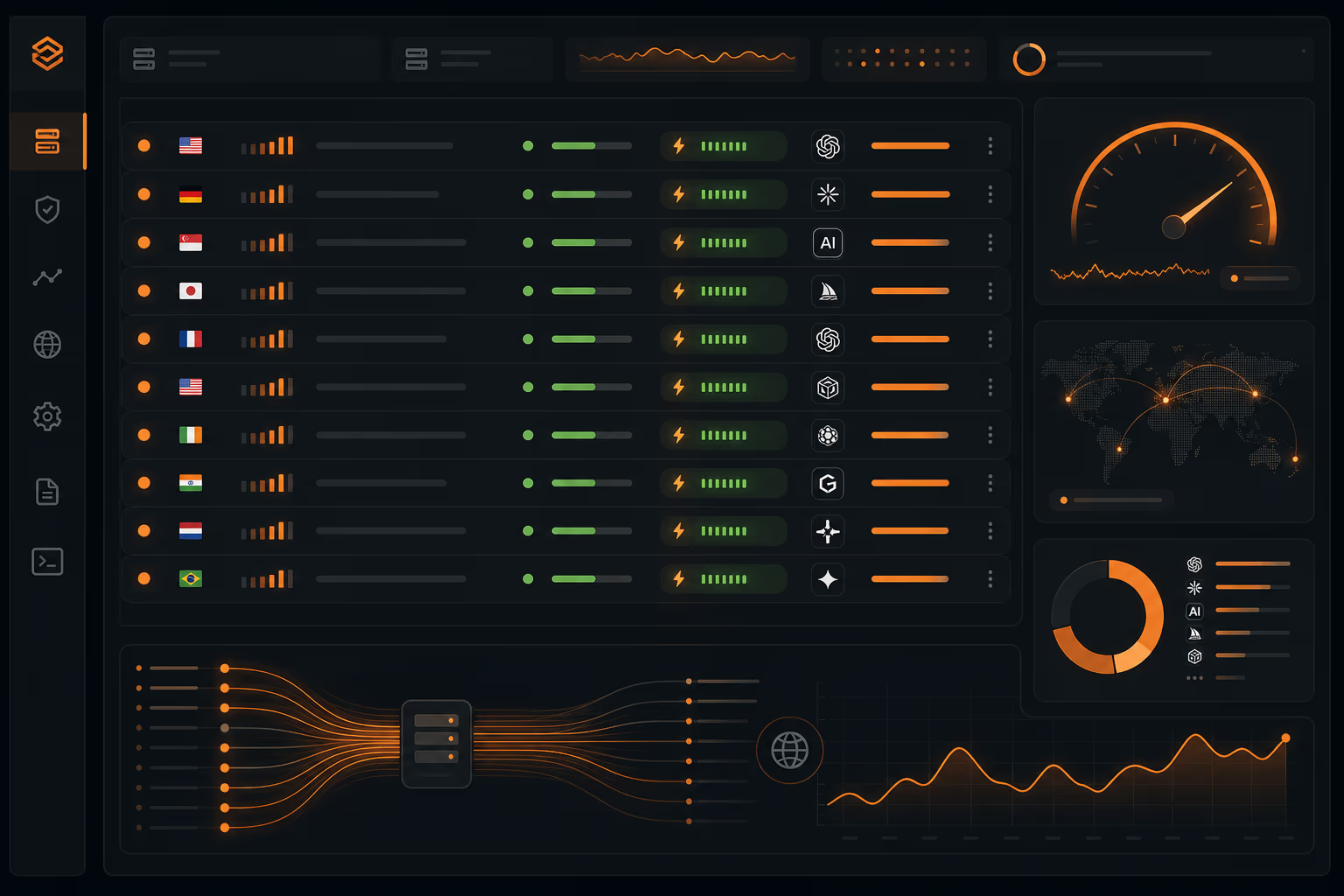
In 2026, the majority of search impressions on many websites no longer come from human users typing queries into a search bar. Instead, they come from machines—AI agents and large language models—researching on behalf of humans. This shift demands a fundamental rethink of technical SEO. Keywords and rankings are no longer the primary lever; what matters is whether machines can efficiently access, parse, and trust your content.
According to aggregated Google Search Console data across hundreds of enterprise sites, query lengths are growing at rates that defy human behavior. Ten-word queries saw a 161% year-over-year increase in 2025, driven by a process researchers call “fan-out,” where a single user prompt is decomposed into dozens of parallel sub-queries [1]. Generative AI traffic itself grew 796% from January 2024 to December 2025, pointing to an irreversible trend [3]. This article cuts through the hype to identify the technical factors that actually determine AI search visibility—and how to optimize for them.
The New Reality of AI-Driven Traffic
Understanding the mechanics of AI search is the first step to adapting your technical SEO. Unlike traditional search engines that crawl and index pages for human consumption, AI agents (the bots behind ChatGPT, Perplexity, and similar tools) have different criteria for surfacing content. They care less about keyword density and more about whether your site can be mechanically ingested and whether it provides authoritative answers to very specific, often multi-part questions.
Server log data from hundreds of enterprise sites consistently shows that AI bots prioritize pages that load cleanly in under 200 milliseconds, are reachable within fewer than four clicks from the homepage, and contain content that answers questions that may never appear in any keyword research tool [1]. This signals a shift from mass keyword targeting to precision answer engineering.
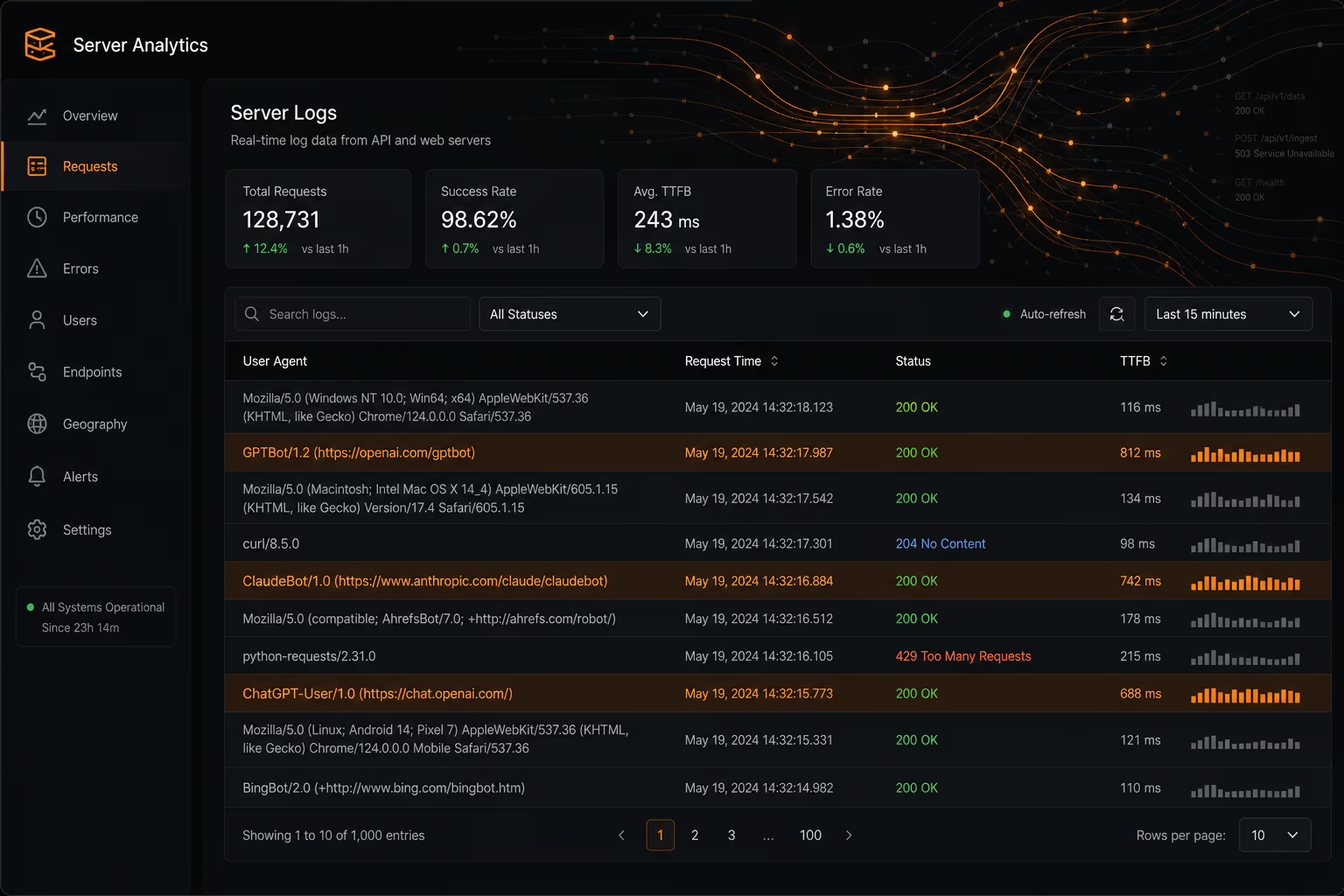
For DigiForge clients, we’ve observed that AI traffic often behaves differently from human traffic: it bursts in spikes when new queries are launched, it has a higher tolerance for technical complexity (like JavaScript, as long as it resolves quickly), but it is unforgiving of slow responses or broken schemas. The challenge is that AI agents are not yet as transparent as Googlebot; many do not openly identify themselves, making server log analysis crucial.
Generative AI traffic continued to grow through 2025 and into 2026. While exact percentages vary, the trend is clear: brands that ignore AI-optimized content risk losing visibility in the fastest-growing segment of search. The key is to treat AI agents as a distinct audience with specific technical requirements.
Key Technical Factors That Matter in 2026
1. Page Speed and Load Time—The 200ms Threshold
AI agents operate under strict timeouts. If your HTML does not begin rendering within 200 milliseconds, the agent moves on. This is not about total page load; it’s about time-to-first-byte (TTFB) and the speed of the initial HTML payload. Server-side rendering (SSR) or static site generation (SSG) becomes nearly mandatory. We recommend monitoring TTFB across your most important pages and using a CDN with edge caching to bring the payload as close to the user (or bot) as possible.
Key stat: A significant portion of search impressions in 2026 are generated by machines that expect HTML to load in under 200ms [1]. Optimizing for this threshold is non-negotiable.
Another often-overlooked factor is JavaScript execution. While AI agents like GPTBot and ClaudeBot can execute some JavaScript, heavy client-side rendering that delays content availability can cause abandonment. Progressive enhancement or pre-rendering critical content is the safer route. For sites built with modern frameworks like React or Vue, consider using server-side rendering or static generation to ensure the HTML payload is complete and fast. Lazy loading of non-critical resources should be implemented carefully to avoid delaying the initial content.
DigiForge recommends regular performance audits using tools like Lighthouse and WebPageTest, but also simulating AI bot behavior by throttling network speeds and measuring TTFB under load. Remember that AI agents may crawl from multiple IPs simultaneously, so CDN and server capacity need to handle burst traffic.
2. Crawl Efficiency for AI Agents
Traditional SEO emphasizes crawl budget for Googlebot, but AI bots have their own crawl patterns. Many do not respect robots.txt in the same way or use different user-agent strings. To ensure AI bots can discover your content efficiently, focus on:
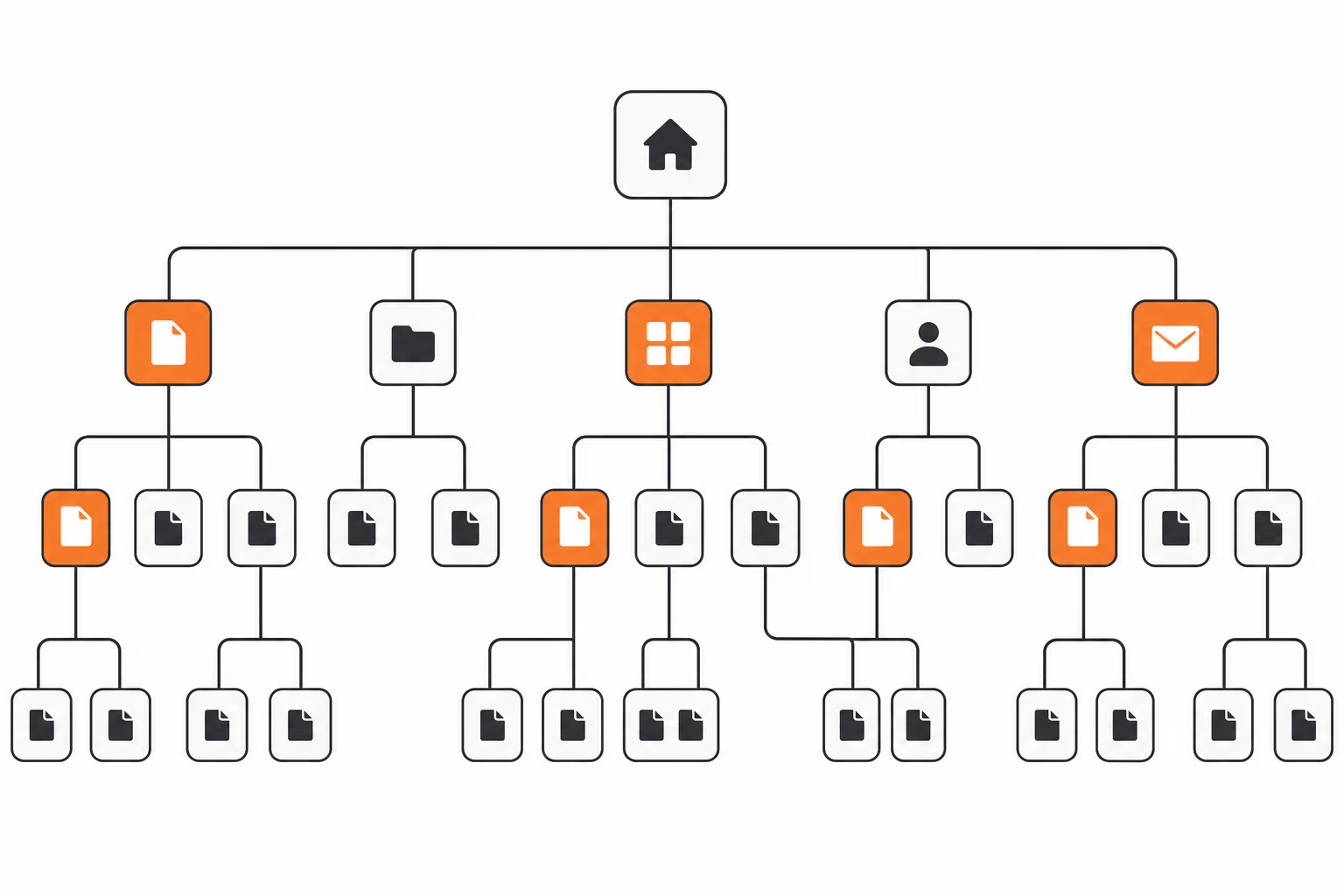
- Flat site architecture: Any page should be reachable within 4 clicks from the homepage, ideally fewer. This reduces the crawl depth and ensures important content is found quickly.
- XML sitemaps: Keep them up to date and reference only canonical pages. Submit them to Google, Bing, and other indexers, but also serve them as a resource for AI crawlers. Sitemaps should be compressed and accessible via a simple URL.
- Avoid infinite loops and parameter-heavy URLs: AI agents might waste crawl budget on low-value pages like filter combinations or session IDs. Use canonical tags and noindex where appropriate. Also, ensure robots.txt is configured to allow AI bots while blocking unwanted crawlers.
- Log analysis: Monitor your server logs for unknown user agents. Identify which AI bots are crawling and how often. Tools like JetOctopus can help automate this [1]. Look for patterns like increased crawl rates after new content publication.
Additionally, some AI agents use shared IP ranges, making it possible to identify them via reverse DNS or user-agent strings. Keep a list of known AI bot user agents (e.g., GPTBot, ClaudeBot, PerplexityBot) and ensure they are not accidentally blocked. If your site uses CAPTCHAs or rate limiting, consider whitelisting these bots to avoid being excluded from AI search results.
3. Structured Data and Entity Clarity
AI models excel at extracting entities and relationships from structured data. Implementing schema markup—especially Article, FAQPage, HowTo, Product, and Organization schemas—provides clear signals that models can parse. Beyond schema, inline annotations (like RDFa or JSON-LD) and consistent entity names help agents build understanding. The key is to use vocabulary that AI models have been trained on, such as Schema.org.
One emerging best practice is to explicitly state the entity your page represents. For example, a page about “lead generation software” should define what that is, who it’s for, and how it relates to other entities. This helps AI agents connect your content to the fan-out queries they generate. Use the sameAs property to link to external knowledge bases (e.g., Wikipedia) for well-known entities, which can boost credibility.
DigiForge recommends implementing JSON-LD for structured data as it is easiest to maintain and least likely to cause errors. Validate your markup using Google's Rich Results Test and Schema.org's validator. Also, ensure structured data is included in the initial HTML response, not injected via JavaScript after load.
4. Content That Answers Specific, Long-Tail Questions
AI agents often decompose a user’s broad question into dozens of sub-queries. Content that directly answers one of those sub-queries—even if the question is rare or never seen in keyword tools—can earn visibility. This means you need to move beyond head terms and address specific pain points, “how-to” steps, and detailed explanations that a model might extract as factual statements. The fan-out effect means that AI-generated queries are often longer and more specific than what a human would type.
- Create content clusters around core topics, with one comprehensive pillar page and multiple supporting articles that answer precise questions. This establishes topic authority and increases the likelihood of being cited across different sub-queries.
- Use clear headings (H2, H3) that mirror natural language questions. For instance, a heading like "How does CRM integration improve lead conversion?" aligns with how AI agents formulate queries.
- Include concise definitions and examples; models often pull from the first paragraph or a well-marked section. Place the most important answer near the top of the content, ideally within the first 100 words.
Additionally, consider creating dedicated FAQ pages or sections that directly answer common questions in your industry. These are often rich snippets in traditional search and can become direct sources for AI answers. Keep answers succinct and factual, and cite sources where appropriate.
5. Trust Signals and Authority
Generative engine optimization (GEO) requires content that is not only accessible but also trustworthy. AI models incorporate some measure of authority when surfacing content. While the exact signals are opaque, we can infer that backlinks from reputable sources, clear authorship, citations (especially linking to primary sources or credible sites), and a strong domain authority play a role. Some AI tools explicitly test for factual consistency and may penalize content with inaccuracies.
Additionally, factual accuracy is paramount. AI models may penalize or ignore content that contradicts known information. Regularly audit your content for outdated statistics or claims and update them. DigiForge recommends a quarterly content freshness audit tied to the latest data in your industry. Also, ensure your About page and author bios are detailed and verifiable, as some AI agents may use them to assess credibility.
Another trust signal is the presence of external links to authoritative sources. When your content cites reputable websites, academic papers, or industry reports, it signals to AI that your content is well-researched. Conversely, linking to low-quality or spammy sites can harm trust. Use the rel="nofollow" attribute judiciously.
How to Measure and Adapt Your Technical SEO
Traditional SEO metrics—like organic traffic, keyword rankings, and bounce rate—are still useful but insufficient for AI search. You need to add new measurements to your reporting stack:
- AI bot crawl count: Number of requests from AI user agents over time. Track the fan-out pattern: spikes may correlate with new queries. Set up alerts for sudden drops in crawl activity.
- Crawl depth distribution: Ensure no page requires more than 4 clicks from homepage for AI bots. Use crawling tools to visualize the depth of your site.
- TTFB for key pages: Average across different page templates; aim for under 200ms. Monitor this weekly as part of performance tracking.
- Structured data coverage: Percentage of pages with valid schema markup. Use Google’s Rich Results Test but also validate with custom tools like Schema Markup Validator.
- Answer relevance: Manually test a sample of your top queries across AI tools (ChatGPT, Perplexity, Gemini) to see if your content is cited. This is a new form of rank tracking. Create a spreadsheet to track which queries trigger your content and how often.
To adapt, start with a technical SEO audit focused on the factors above. Use server log analysis to identify crawling issues, then prioritize speed improvements, architecture flattening, and structured data implementation. Remember that AI search is still evolving, so an agile approach—testing and iterating monthly—is best. DigiForge uses a combination of automated tools and manual review to ensure no blind spots.
One additional measurement is the brand mention in AI-generated answers. Tools like Perplexity's discover feature or manual checks can help. If your brand appears as a source in AI outputs, that's a strong signal you're doing something right. Encourage satisfied customers to leave reviews on third-party sites, as AI may incorporate those signals into authority assessments.
Integrating AI SEO into Your Existing Strategy
AI optimization should not replace traditional SEO; it should layer on top of it. The fundamentals—quality content, technical hygiene, link building, and user experience—remain critical. However, you should now also consider:
- Content organization: Group related topics into clusters to signal thematic depth to AI agents. Use internal linking to strengthen entity associations.
- Regular updates: AI models often prefer fresh content. Keep core pages updated with the latest information, and mark updates with
lastmodin sitemaps. - Mobile optimization: Many AI queries originate from mobile devices, but AI agents also retrieve content for mobile users. Ensure responsive design and fast mobile load times.
- Accessibility: AI agents benefit from the same accessibility features as human users—clear headings, descriptive alt text, semantic HTML. These improve parseability.
Collaboration between SEO teams and content creators is essential. Writers should understand how AI might use their content and structure it accordingly. For example, using bullet lists for key points, defining terms upfront, and avoiding ambiguous language all help AI extract facts accurately.
Conclusion
Technical SEO for AI search in 2026 is not about abandoning the fundamentals—it’s about layering new priorities on top of them. Speed, crawl efficiency, structured data, precise answer content, and trust signals form the new foundation. By monitoring server logs and adapting to the fan-out nature of AI queries, businesses can capture visibility in the fastest-growing segment of search.
At DigiForge, we’ve helped clients navigate this transition by treating AI agents as a distinct audience—one that rewards technical excellence over keyword tricks. The time to act is now, while the landscape is still forming. If you need a partner to audit your technical SEO for the AI era, contact us.
Sources
- How To Run a Technical SEO Audit for AI Search Visibility
- How to adapt and future-proof your SEO strategy for AI search results
- How to adapt and future-proof your SEO strategy for AI search results
- BrandClickX.com Launches as a Go-To Source for Marketing News, AI Strategy, and Brand Intelligence for Business Leaders